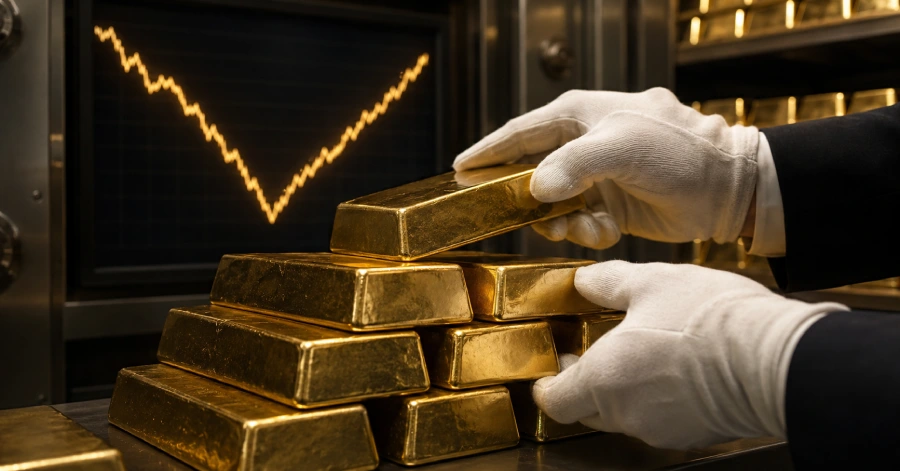
Last week, gold slipped below $4,000 per ounce and sentiment turned bleak. Bearish forecasts multiplied. Many investors sold. This Wednesday July 22, gold has rebounded to a two-week high near $4,130 — a gain of roughly 3.4% from those lows — and the reason cited by analysts is telling: market participants concluded the fall below $4,000 was excessive. For the contrarian buyer who accumulated during the gloom, this is exactly the outcome the discipline is built for. And the case from here remains compelling.
Consider what has changed in just a few days. First, a rare diplomatic opening: mediators have proposed a 10-day ceasefire, and Iran’s Interior Minister travelled to Pakistan to advance the effort. Second, the Federal Reserve outlook steadied — a Reuters poll of economists now shows the Fed expected to hold rates through the rest of 2026, removing a headwind that had weighed on gold all through the conflict. Third, technical buying kicked in as gold broke above the downtrend that had been in place since July 6. Three supports appeared where recently there was only pressure.
But the deepest reason for the rebound is the one that never went away. Goldman Sachs stated this week that persistent central bank buying, led by China, continues to provide a price floor for gold, and the bank maintains a year-end target near $4,900. This is the essential contrarian insight: while retail sentiment panicked at sub-$4,000, the world’s sovereign institutions were accumulating. They buy gold not for next week’s price but as a strategic reserve — a hedge against monetary and geopolitical risk that no government can print. Poland has been among the largest net buyers, and China’s central bank has been purchasing at its fastest pace in over two and a half years. When the price fell, they bought. That accumulation built the floor from which today’s rebound launched.
Now consider the asymmetry that remains. Gold is drawing support from both directions of the conflict. If diplomacy progresses and a ceasefire holds, oil falls, inflation eases, the Fed is freed, and gold rallies on the rate channel. If instead the conflict deepens — and US strikes continued for an eleventh night while tankers reversed course in the Red Sea — gold’s safe-haven role reasserts itself, as we are already seeing with gold and oil rising together. Both paths support the metal.
The value proposition at today’s price remains strong. Gold at $4,130 is still about 26% below January’s record of $5,597 and down 22% since the war began — meaning substantial recovery potential remains. Yet it is up 21% over the past twelve months, slightly ahead of the S&P 500. Goldman’s $4,900 target implies roughly 19% upside from here.
Honesty requires noting the risks: September hike odds remain elevated near 64% to 68%, the 30-year Treasury yield near 5.13% keeps opportunity cost high, and the ceasefire is only a proposal that Washington has publicly doubted. The July 28–29 Fed meeting could move the market sharply either way.
But the pattern is clear. The market overshot to the downside, the smart money bought, and the recovery has begun. The gateway that opened widest at sub-$4,000 is still open at $4,130 — narrower than last week, but open.
24K: $132.80/gram | 22K: $121.75/gram | 21K: $116.20/gram
All prices USD. Wednesday July 22 indicative rates.