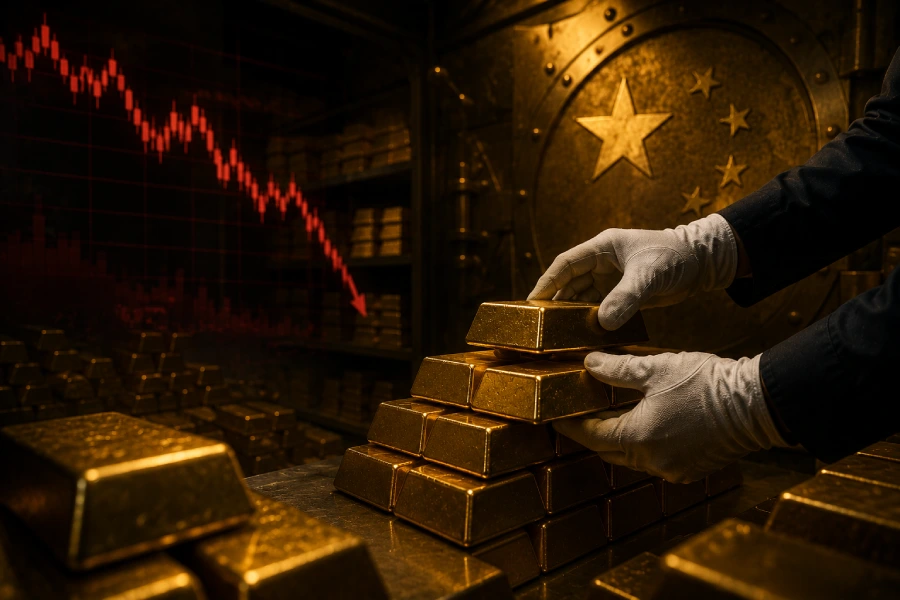
Here is a fact that deserves every gold buyer’s full attention. In June, as gold prices fell and sentiment turned bleak, China’s central bank reported its largest monthly increase in gold reserves in more than two and a half years. The most strategically patient buyer on earth accelerated its accumulation precisely at the moment of maximum price weakness. And this Monday July 13, with gold falling further to around $4,020 — roughly 28% below its January record and the deepest discount of the year — the signal could not be clearer. When the smartest money buys aggressively into weakness, the contrarian pays attention.
Consider what is actually happening. Gold is falling because the Middle East war has re-erupted: Iran has declared the Strait of Hormuz closed, the US has struck 140 Iranian targets, and oil has surged 7% to $81.40 a barrel. Higher oil means higher inflation, which means the Federal Reserve is expected to raise rates — markets now price nearly 70% odds of a September hike. Rising rates strengthen the dollar and pressure non-yielding gold. The mechanism is clear.
But now think about what that mechanism actually is. Every force pushing gold down today is monetary and cyclical: interest rate expectations, dollar strength, inflation fears. These are, by their very nature, temporary. Interest rate cycles turn. Oil shocks resolve when the conflict driving them resolves. Dollar strength mean-reverts. Not one of these forces represents a permanent change in gold’s value. They are the weather, not the climate.
Meanwhile, the forces that permanently determine gold’s value are strengthening. Central banks — sovereign institutions that hold gold as a strategic reserve, immune to short-term sentiment — are buying more aggressively, not less. China leads, at its fastest pace in over two and a half years. They buy because of the near-$39 trillion US debt, the erosion of confidence in paper currencies, and the accelerating shift toward a multi-polar world where no single nation’s currency can be fully trusted. War and rate scares do not change these facts — if anything, they reinforce them.
Now consider the value at today’s price. Gold at $4,020 is roughly 28% below January’s record of $5,597. That is the deepest discount available all year. Yet the metal remains up 19.5% over the past twelve months, meaning even at this “crash” level, long-term holders are substantially ahead. Analysts identify $3,920 as key technical support and $4,500 as the breakout trigger that would signal renewed upside.
And here is the contrarian’s key insight about the war itself. Gold is falling because of the war — but only through the inflation-rate channel. If the conflict resolves and oil falls, inflation eases, the Fed pivots, and gold rallies. If the conflict deepens and becomes a genuine crisis rather than an oil-price event, gold’s safe-haven role reasserts itself and gold rallies. Both paths ultimately lead higher.
The gateway opens widest when the headlines are darkest, and today they are very dark. But the world’s central banks — buying at the fastest pace in years — are walking through it. This week’s Warsh testimony and CPI report will bring volatility. The patient buyer at $4,020 is following the smartest money in the world.
24K: $130.00/gram | 22K: $119.20/gram | 21K: $113.75/gram
All prices USD. Monday July 13 indicative rates.